SpO₂ Sensors & Extension Cables — Getting Compatibility Right
Learn how to choose the right SpO₂ sensors and extension cables by understanding connector types, lengths, and designations for reliable oxygen monitoring.
Read article
 USA
USAChoose reusable SpO₂ sensors for high-throughput units that can reliably reprocess devices, and disposable sensors where infection control, single-patient workflows, or fit constraints dominate. Many hospitals use a mixed model by care area rather than forcing one sensor policy everywhere.
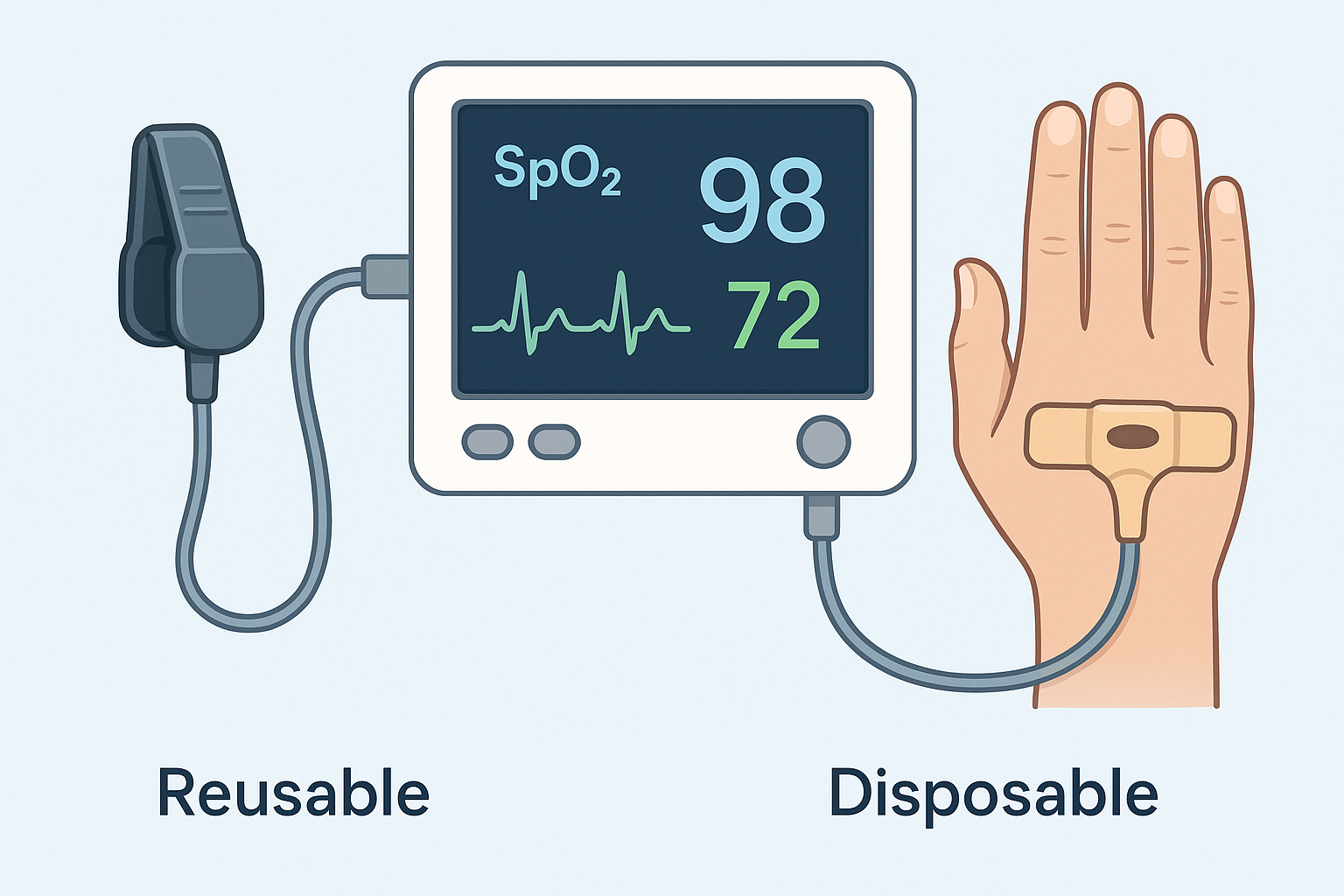
Pulse oximetry is one of the most widely used monitoring tools in modern healthcare. From the ICU to the OR, and even during emergency transport, the ability to measure a patient's oxygen saturation (SpO₂) in real time is essential for safe care. At the heart of this technology lies the sensor — the small but critical accessory that sits between patient and monitor.
Hospitals and health systems face an important choice: should they rely primarily on reusable SpO₂ sensors, designed to be cleaned and cycled through patients, or disposable sensors, which are intended for single-patient use? Each approach has clear strengths and drawbacks. The wrong choice can create unnecessary costs, infection risks, or inaccurate readings, while the right approach can improve patient outcomes and operational efficiency.
This post explores the advantages and limitations of reusable and disposable SpO₂ sensors, highlights the contexts where each is most appropriate, and provides practical guidance for clinical and procurement teams making this decision.
| Factor | Reusable | Disposable |
|---|---|---|
| Best for | High daily volume with strong reprocessing | Isolation, OR, or single-patient workflows |
| Cost profile | Higher upfront, lower per use over time | Lower upfront, higher consumable spend |
| Infection control | Depends on cleaning compliance | Supports single-patient use policies |
| Main risk | Reprocessing lapses; wear over cycles | Supply cost and waste if overused |
Pulse oximeters estimate oxygen saturation by passing light through tissue and detecting how much is absorbed by oxygenated vs. deoxygenated hemoglobin. Accuracy depends not just on the monitor's internal algorithms, but on the fit, quality, and condition of the sensor.
A degraded or poorly matched sensor can:
Because oxygen monitoring is central to patient safety, the choice between reusable and disposable sensors has both clinical and operational consequences.
Reusable sensors are designed for longevity. Constructed with rugged housings, durable cables, and washable surfaces, they can withstand hundreds of patient uses with proper care.
Clinical insight: In one cardiac ICU, switching from single-use sensors to reusables saved over $50,000 annually. However, the hospital had a centralized disinfection unit that could guarantee compliance. Without that infrastructure, savings could have been offset by increased infection rates.
Disposable sensors are intended for single-patient use. Most are made of flexible materials and come in adhesive wrap or foam styles.
Clinical insight: A Level I trauma center adopted disposables in its ED after repeated issues with reprocessing delays. Staff satisfaction improved, and turnaround times dropped — but the supply chain team had to negotiate bulk purchasing to keep costs sustainable.
Confirm monitor matching with SpO₂ compatibility 101 and review options in the SpO₂ sensors category. Extension needs are covered in the SpO₂ sensors and extension cables guide. For clinical context on SpO2 vs PaO2 oxygen measurements, see the educational overview.
Whether reusable or disposable, compatibility with the monitor is non-negotiable. SpO₂ sensors are not universally interchangeable. They must match the monitor's protocol family (e.g., Nellcor-style, Masimo-style, OxiMax-style).
A common pitfall: purchasing a disposable sensor that "looks" compatible but fails to communicate properly with the monitor. Always verify by monitor brand and model, not just by connector shape. Procurement teams should maintain up-to-date cross-reference tables for every unit.
For facilities using reusables, strong protocols protect both patients and investments:
By embedding care into workflows, hospitals extend the life of their sensors and reduce unexpected failures.
A successful SpO₂ sensor strategy requires staff education and workflow design. Consider:
Procurement teams face competing pressures: reduce costs while improving patient outcomes. Here's what they should consider:
At Medten, we understand that no two hospitals are alike. That's why we offer both reusable sensors for long-term cost efficiency and disposable sensors for infection-control and specialty populations. Every product is rigorously tested for signal quality, durability, and compatibility with leading monitor brands. By choosing Medten, facilities gain flexibility without compromising on patient safety.
Explore Our SpO₂ Sensor Solutions Here
This content is provided for informational purposes only and does not constitute medical advice. Always follow your institution's protocols and manufacturer guidelines.
Keep reading
More articles you may find helpful from the Medten blog.