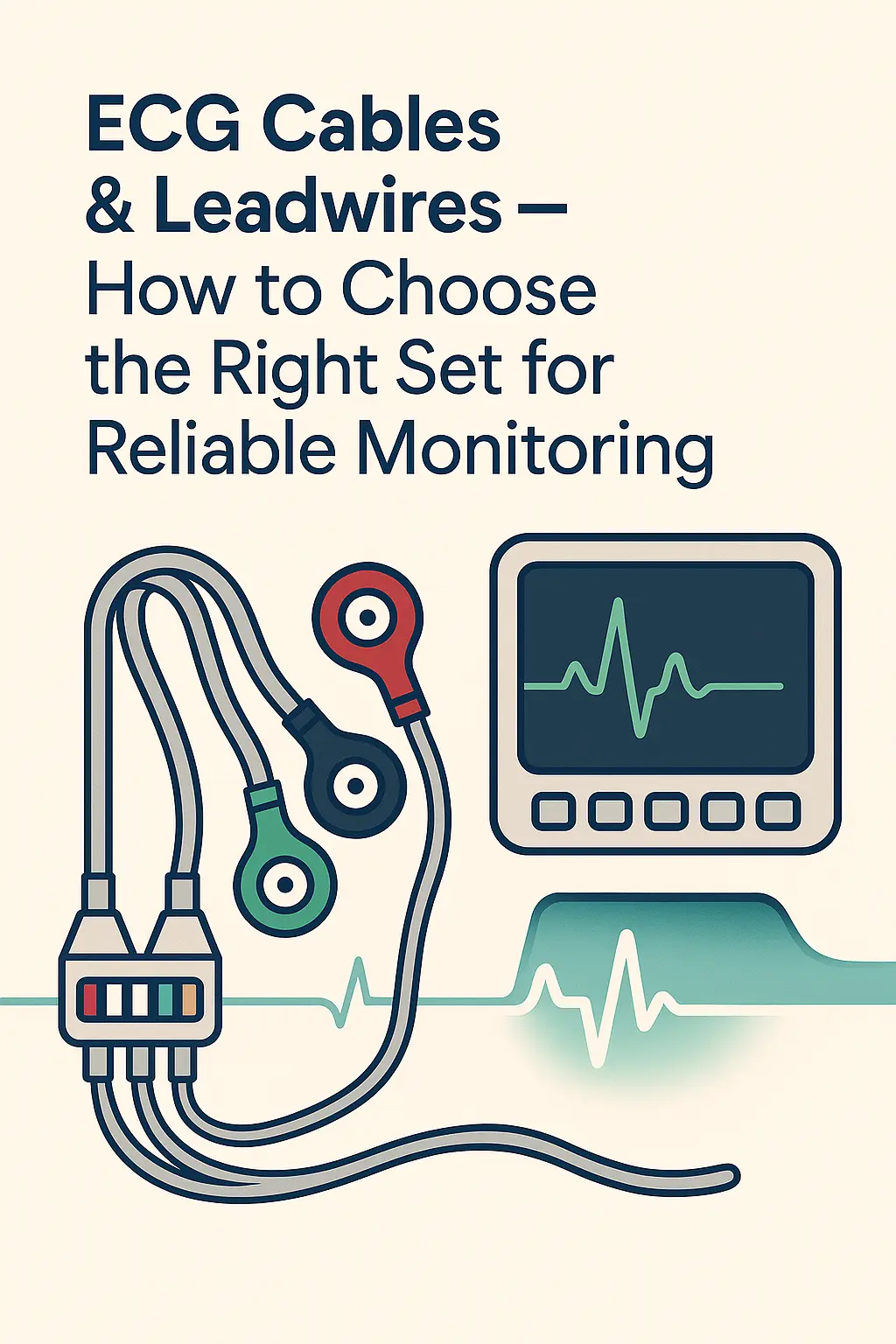
ECG Cables & Leadwires — How to Choose the Right Set for Reliable Monitoring
Choose ECG cables and leadwires by matching your monitor connector, lead count (3/5/10), labeling standard (AAMI or IEC), and durability needs. Verify trunk and leadwire configuration before ordering so replacements preserve signal quality, reduce placement errors, and avoid avoidable service calls.
Andres Orjuela·Published September 23, 2025·Updated July 15, 2026·6 min read·Product Tips
Introduction: The Foundation of Accurate ECG Monitoring
In patient monitoring, accurate ECG readings start with the connection. The quality and compatibility of your ECG cables and leadwires directly affect signal clarity, uptime, and patient safety. Whether you manage a procurement department or oversee device maintenance, understanding how to choose the right ECG set saves time, money, and troubleshooting later.
This guide walks through how ECG cables and leadwires work, what specifications to consider, and how to streamline ordering across multiple monitor brands.
Understanding the ECG Cable Set
An ECG system consists of two main parts:
Trunk Cable: Connects the monitor to the patient-side leadwires.
Leadwires: Connect the trunk cable to individual electrodes on the patient.
Trunk cables vary in length, flexibility, and connector design. Leadwires come in several configurations — most commonly 3-lead, 5-lead, or 10-lead — depending on how many electrical vectors you need to capture.
When selecting replacements, start with your monitor's connector type and pin configuration. Even within the same brand, models may differ, so cross-check the connector code and labeling standard (AAMI or IEC). For purchasing teams, see the medical cable compatibility guide for hospital buyers.
Connector Types & Compatibility
Connector types determine whether your cable set is plug-and-play or requires adapters. Common examples include snap and clip leads, DIN-style connectors, and brand-specific keyed housings.
A few quick rules of thumb:
Snap connectors are common in ICU or long-term monitoring because they resist accidental detachment.
Clip connectors are convenient for faster electrode changes during stress testing or outpatient monitoring.
When replacing legacy systems, verify the part number and labeling printed near the trunk connector or Y-split of your current cables. That small step prevents misorders and ensures precise ECG readings.
Material and Durability Considerations
Cable jacket material matters more than it seems. Modern ECG cables use TPU or silicone sheaths that resist kinking and are easier to disinfect. If you're sourcing for a high-usage environment (e.g., telemetry units), prioritize strain-relief designs and reusable, latex-free materials.
For mobile carts or portable monitors, shorter lengths (2–2.5m) reduce tangling, while longer lengths (3.5–4m) are ideal for bedside monitoring.
Look for markings such as CE certification or ISO 13485 compliance — they indicate standardized quality and manufacturing consistency.
Lead Count and Monitoring Setup
Lead count affects how much cardiac information the monitor receives:
3-lead: Basic rhythm detection; typically used in transport or recovery.
5-lead: Adds a chest lead for more accurate cardiac positioning.
10-lead (12-lead ECG): Used for diagnostic readings and clinical ECG exams.
Each lead count has its own connector pin layout. Double-check your monitor's label or operator manual before ordering replacements or backups.
Cleaning & Maintenance Tips
Consistent maintenance extends cable life and prevents signal noise. Follow these practices:
Wipe cables with approved hospital disinfectants after each use.
Avoid submersion in liquids.
Coil cables loosely; avoid sharp bends near connectors.
Replace cables showing frayed insulation or intermittent signals.
Regular inspection schedules help detect wear early and keep readings accurate. Persistent noise or false alarms may need ECG artifact troubleshooting.
Procurement Checklist
Specification
Example
Why It Matters
Lead Count
5-lead
Matches monitor configuration
Connector Type
Snap
Prevents accidental disconnection
Jacket Material
TPU
Durable and easy to disinfect
Cable Length
3.6m
Ideal for bedside monitoring
Labeling
AAMI
Ensures standardized color coding
Final Thoughts
ECG cables and leadwires may seem simple, but choosing correctly keeps your monitoring systems running seamlessly. Standardize your setups, document connector codes, and work with suppliers who understand cross-brand compatibility. Doing so ensures consistent signal quality—and peace of mind that every reading is accurate.
Learn how to prevent cable failures that compromise patient monitoring. Get practical tips for inspection, maintenance, and replacement to ensure reliable patient care.
Learn how to choose the right SpO₂ sensors and extension cables by understanding connector types, lengths, and designations for reliable oxygen monitoring.
Learn the essential questions procurement teams should ask when evaluating compatible patient monitoring accessories. Ensure safety, compliance, and cost-effectiveness.
Master the art of troubleshooting patient monitoring signals. Get a structured playbook to quickly identify and resolve common ECG and SpO₂ signal issues.